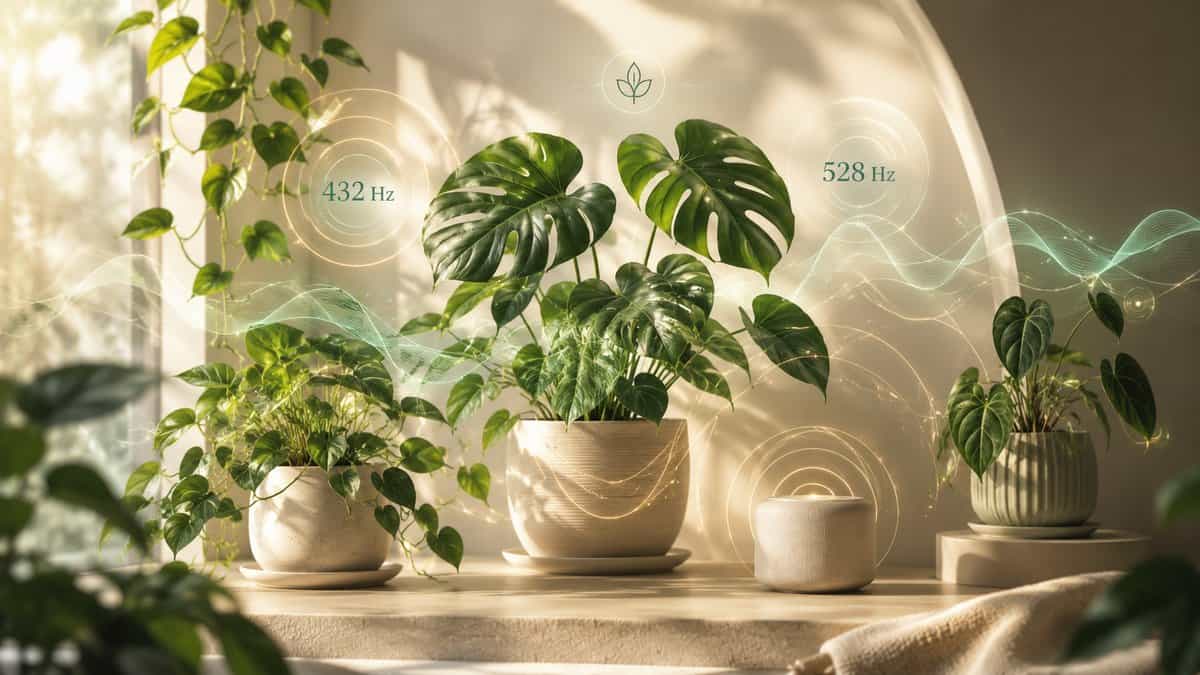
Sound Frequencies for Plants & People: The Complete Guide
🎵 Part of my Music for Plants hub.
For everyday plant growth, most people start with 432 Hz. For a stronger boost during recovery, many switch to 528 Hz. For people, the Solfeggio tones are used for relaxation and focus, not as medical treatment.
Bring these frequencies to your plants
Plant House & Garden’s original Sound Therapy collection is calm companion music I made to play during everyday plant care. No cures, no claims, just a peaceful soundtrack for you and your plants.
Explore Plant Sound Therapy →What Sound Frequency Actually Means
Every sound is a vibration travelling through the air, and frequency is how fast that vibration repeats, measured in hertz. A low hum is a low frequency. A bright, high note is a high frequency.
I share new music for plants and sound experiments on my channel all the time, so if this interests you, watch the videos and subscribe here.
Most modern music is tuned so the note A is 440 Hz. When music is retuned slightly lower, to 432 Hz, many people describe it as softer, warmer and more relaxing. That small shift is the root of the whole frequencies for plants and people world, and it is why so much of the music I make is tuned to these specific numbers. If you want the deeper background, I cover it in 440 Hz vs 432 Hz: What Is the Difference.
How Plants Respond to Sound and Vibration
Plants do not have ears, so they do not hear music the way we do. But they are remarkably sensitive to their environment, including vibration. There is real, emerging research showing plants can detect vibrations, for example the sound of a pollinator or, in some studies, reactions to sound waves at the cellular level.
I want to be clear and fair here: this field, sometimes called plant bioacoustics, is genuinely interesting but still early, and results are mixed. So I do not claim that a specific frequency guarantees faster growth. What I can say from my own experience is that giving plants a calm, stable, low stress environment helps them, and gentle background sound is one easy way to create that. If this fascinates you, I go deeper in Can Plants Feel Vibrations.
How People Respond to Sound Frequencies
This is the other half of the story, and it is just as important to me, because I make this music for people as much as for plants. Humans have used sound for relaxation, focus and ceremony for thousands of years. Slow, low tuned music tends to calm the nervous system, and that is something most of us can feel immediately.
An honest note: the human benefits attached to individual Solfeggio tones, things like emotional release or DNA repair that you see online, are traditional and anecdotal ideas, not established medical facts. I share them because they are part of the culture and history of these tones, and because many people find the music genuinely relaxing. None of this is medical advice or a treatment for any condition.
The Key Frequencies, Explained
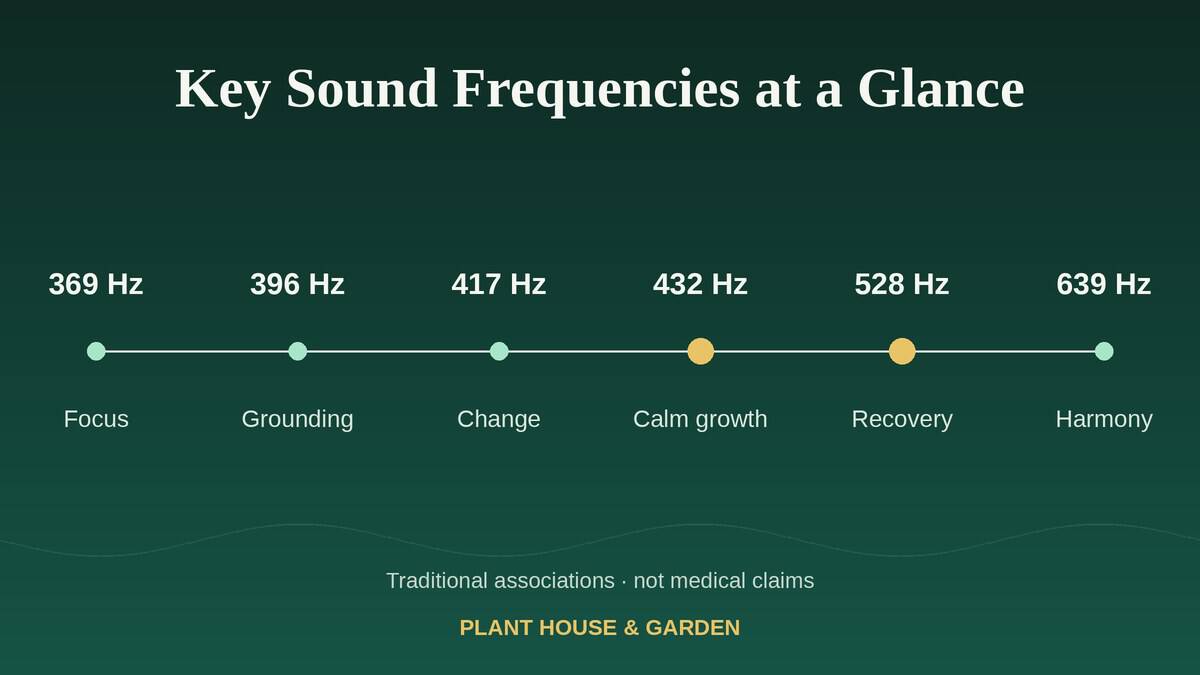
Here is a quick map of the sound frequencies for plants and people you will see most often. Remember, the associations below reflect traditional and anecdotal ideas, not proven effects.
| Frequency | Traditionally associated with | Commonly used for | Guide |
|---|---|---|---|
| 396 Hz | Releasing fear, grounding | Calm, letting go | Read |
| 417 Hz | Change, clearing energy | Fresh starts, focus | Read |
| 432 Hz | Natural, calming tuning | Everyday plant care | Read |
| 528 Hz | The miracle repair tone | Recovery, vitality | Read |
| 639 Hz | Connection, harmony | Relationships, balance | Read |
| 369 Hz | Tesla number code | Focus, manifestation | Read |
| Solfeggio set | Ancient sacred scale | The full toolkit | Read |
| Rife frequencies | Targeted healing tones | Curiosity, research | Read |
| Schumann (7.83 Hz) | The Earth natural pulse | Grounding atmosphere | Read |
432 Hz, the everyday favorite
432 Hz is where almost everyone starts. It is gentle, natural and easy to play all day at low volume. If you only ever use one frequency for your plants, this is the one I recommend as your baseline. Full guide: 432 Hz Frequency Explained.
528 Hz, the boost tone
528 Hz is the one I reach for when a plant looks tired, stressed or stuck, for example after repotting or a hard winter. It is part of the Solfeggio scale and is often called the tone of renewal. Full guide: 528 Hz Frequency, the Miracle Tone.
417 Hz, the highest interest tone right now
417 Hz is one of the most searched frequencies, associated with change and clearing stuck energy. Full guide: 417 Hz Frequency Benefits.
The Solfeggio scale, 396 to 963 Hz
The Solfeggio frequencies are an ancient set of tones, each traditionally tied to a different intention. To understand the whole system, start with Solfeggio Frequencies Explained. For the individual tones, see 396 Hz, 417 Hz and 639 Hz.
Rife and Schumann, for the curious
Rife frequencies are a separate, more controversial idea, and I cover them honestly in Rife Frequencies Explained. The Schumann Resonance, around 7.83 Hz, is the natural pulse of the Earth, and many people love it as a grounding background for plants.
So What Is the Best Frequency for Plant Growth?
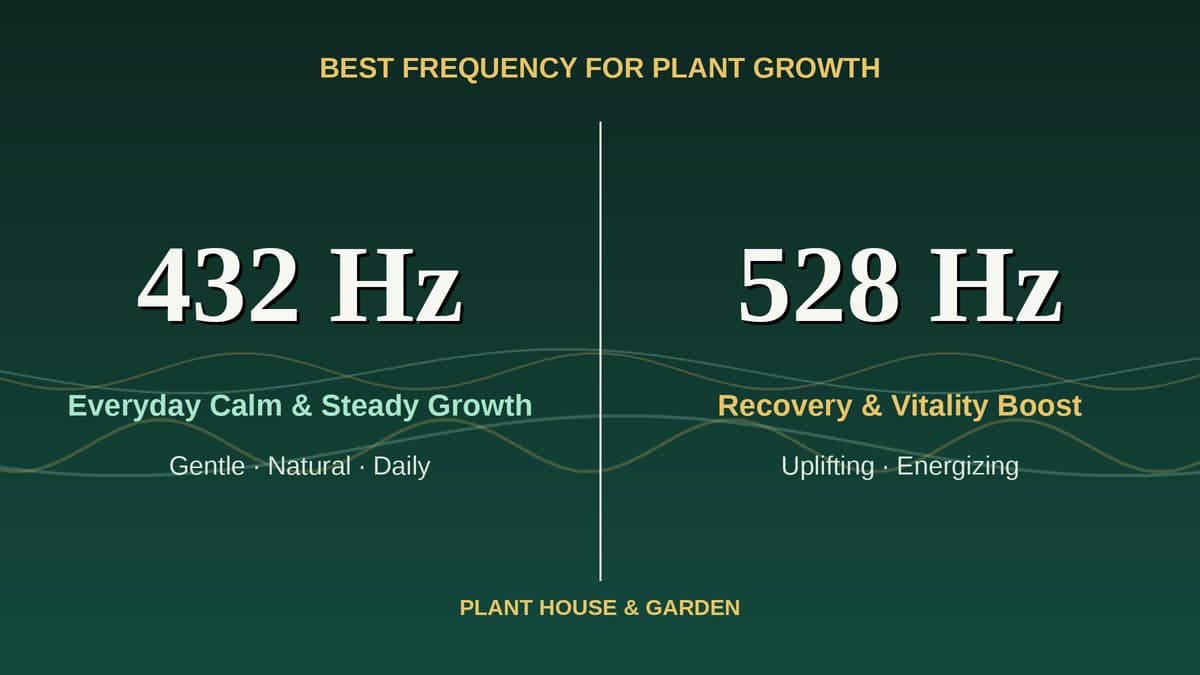
This is the question I get most, and the honest answer is that it depends on your goal. For steady, everyday growth, 432 Hz is the favorite. For recovery and a stronger push, 528 Hz. I ran a full side by side comparison in my tested guide: 432 Hz vs 528 Hz, the Best Frequency for Plant Growth. If you cannot decide, you do not have to. I often play a blend of both, and you can listen to it right here:

Pure Tones vs Music: What Is the Difference?
There are two ways to use frequencies. The first is music tuned to a frequency, which is pleasant to listen to all day. The second is a pure tone, a single steady frequency with no melody, which some people prefer for focused sessions. I make both. If you want to try pure tones, start with Healing Music with Pure Tones, and for the two most popular: 432 Hz Pure Tone and 528 Hz Pure Tone. Here is my 528 Hz pure tone session for plants and people:

How to Use Sound Frequencies
You do not need special equipment. A phone and a small speaker are plenty. Here is the routine I recommend:
- Play it 1 to 8 hours a day. Consistency matters more than length.
- Best time is daytime, when plants are most active in the light.
- Keep the volume low to medium. Soft background sound is the goal, not loud vibration.
- Place the speaker near your plant shelf, not directly on the pot.
- Use it during plant care moments, like watering, repotting or cleaning leaves, so it becomes a calm ritual for you too.
For people, the same music works beautifully for meditation, reading, sleep or winding down in the evening. Let it be enjoyable rather than a chore.
The Science and My Honest Promise to You
I want this page to be the one you can trust, so here is where I stand. The basics of plant care, light, water, humidity and soil, are settled science and always come first. The idea that sound and specific frequencies meaningfully boost plant growth is interesting and supported by some early research, but it is not proven or conclusive. The human benefits tied to individual tones are traditional and anecdotal, not medical fact.
I do not share this music to make big promises. I share it because I genuinely enjoy it, my plants live in a calm space, and many of you tell me it helps you relax. If you enjoy the deeper why, the patterns of nature are endlessly inspiring: The Golden Ratio Explained, The Fibonacci Sequence Explained, and the much debated Masaru Emoto Water Research. For the simplest overview, see How Music Can Affect Plant Growth and The Magic of Plant Growth Music Frequencies.
Ready to Listen? My Music for Your Plants
If you just want to press play, this is my main, most loved track for plants and people, tuned to 432 Hz. You can also explore the full Music for Plants 432 Hz guide or my Music for Plants playlist on YouTube.
Plant Sound Therapy: Frequencies for Specific Goals
Beyond general growth music, I have explored more targeted sound therapy sessions for specific situations. These are experimental and fun to try alongside good care:
- General sessions: Plant Sound Therapy for Healthy Growth and Plant Growth Frequency Sound Therapy
- For pests: Sound Therapy for Pest Control and Aphid Protection Sound Therapy
- For blooming: Flowering and Fruiting Frequency
Prefer a Hands-On Method? Try Electroculture
If you love the idea of supporting plants with natural energy, you might also enjoy electroculture, a simple copper antenna method I have tested with real results: What Is Electroculture, How to Build a Copper Atmospheric Antenna, and my Amazing Results After 2 Weeks.
Frequently Asked Questions
What is the best frequency for plant growth?
For everyday growth, most plant lovers choose 432 Hz because it is gentle and easy to play daily. For recovery and a stronger boost, 528 Hz is the popular pick. Neither replaces light, water and good soil, they support a calm environment on top of solid care.
Do sound frequencies really make plants grow faster?
The honest answer is that the research is early and mixed. Some studies suggest sound vibration can influence plants, others find little effect. I treat frequencies as a calming, enjoyable layer over proper plant care, not a guaranteed growth booster.
Are these frequencies safe for people?
Yes, listening to music or pure tones at a comfortable volume is safe for most people. It is for relaxation and enjoyment, not medical treatment, and it is not a substitute for professional care for any health condition.
How long should I play frequency music each day?
A simple routine is 1 to 3 hours a day, though you can play it longer at low volume if the environment stays stable. Consistency matters more than how long each session is.
What is the difference between 432 Hz and 528 Hz?
432 Hz is a calm, natural tuning used for daily, steady growth. 528 Hz is a Solfeggio tone associated with renewal and recovery, often used when a plant looks stressed or slow. Many people use both together.
Can I play frequency music for my plants at night?
You can, but it is not necessary. Plants are most active during the day because of light, so daytime is usually best. At night, keep the volume low and use it mainly for a calm atmosphere.
Final Thoughts
Sound frequencies for plants are one of the most enjoyable parts of caring for them, as long as we keep them in their proper place: a gentle, calming layer on top of great light, water and soil. Start with 432 Hz, add 528 Hz when your plants need a boost, explore the Solfeggio tones for yourself, and most of all, enjoy the calm it brings to your space. Your plants, and you, deserve it.

Written by Bojana
Plant lover, grower, and music maker behind Plant House & Garden, with 35+ years of hands-on houseplant experience. Read more about Bojana →
A note from Bojana: I share sound frequencies like 432 Hz from years of personal experience and hands-on experimenting with my own plants. I want to be honest with you: the science on whether specific frequencies directly affect plant growth is still limited and not conclusive. So throughout this site I describe what I have observed and what others report, rather than promising guaranteed results. Think of these frequencies as a calming, supportive practice to enjoy alongside good plant care, not as a medical treatment or a replacement for light, water, and healthy soil.