Golden Ratio Explained: How Nature, Plants & Fibonacci Create Perfect Harmony
The golden ratio is one of the most fascinating patterns found throughout nature – from the spirals of galaxies to the way leaves grow on your favorite houseplants. This mathematical constant, known as phi (1.618…), appears everywhere life organizes itself. It shapes beauty, balance, growth, and harmony across the natural world.
Today, we’ll explore what the golden ratio is, how it works in nature and plants, how it connects with the Fibonacci sequence, and why it plays a role in frequencies, music, and natural harmony.
Let’s dive in.
What Is the Golden Ratio (Phi)?

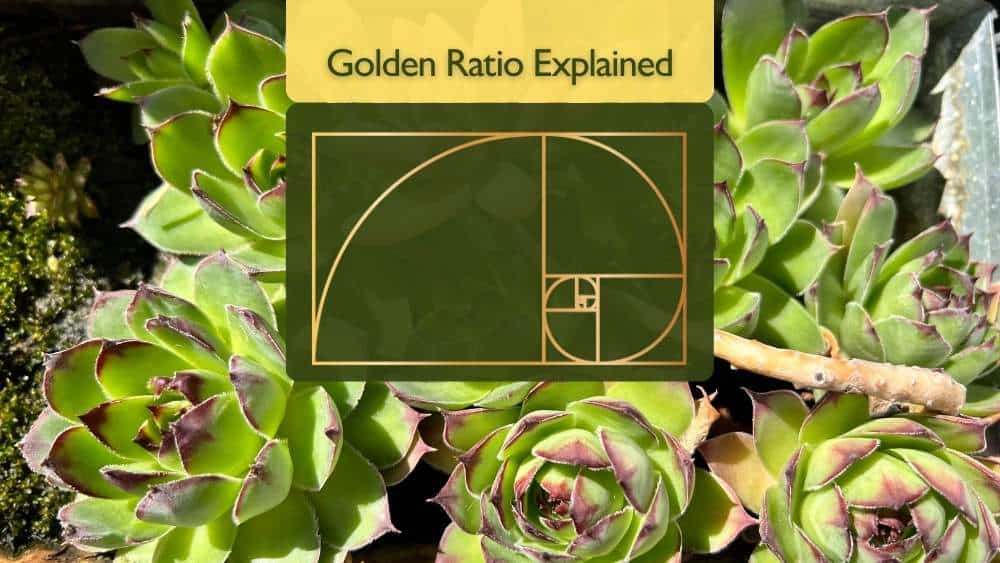
The golden ratio is a special mathematical proportion written as 1 : 1.618. It appears when you divide something – like a line, a leaf, a shell, or even a flower – in a very specific way: the smaller part relates to the larger part in the same way the larger part relates to the whole. Even if this sounds abstract at first, the idea becomes much clearer once you see how often it shows up in nature.
This proportion fascinated ancient architects, philosophers, and artists because it creates shapes that feel naturally balanced and beautiful. But what’s even more fascinating is that nature was using the golden ratio long before humans ever recognized it. Plants, shells, storms, and even galaxies follow this pattern because it represents the most efficient way for life to grow. It helps organisms expand with minimal energy, organize themselves without wasting space, and position their leaves and structures in ways that maximize sunlight and stability.
In simple terms, the golden ratio is nature’s built-in formula for balance, harmony, and efficient growth. It’s a quiet rule that shapes the world around us, even when we don’t notice it.
Golden Ratio and Fibonacci – How They Are Connected
The Fibonacci sequence — 1, 1, 2, 3, 5, 8, 13… – is a simple pattern where each number is created by adding the previous two. At first it looks purely mathematical, but as the sequence grows, something fascinating happens: the ratio between the numbers gets closer and closer to phi, the golden ratio. This means that the golden ratio isn’t just a random number – it naturally emerges from the way things grow.
This connection is the reason so many forms in nature follow both Fibonacci patterns and the golden ratio at the same time. Spirals in shells and sunflowers, the way branches divide, how leaves arrange themselves around a stem, and even the structure of many plant species all reflect this hidden mathematical relationship. Nature uses these patterns because they allow for the most efficient distribution of light, space, and energy.
If you’ve already read my article Fibonacci Sequence Explained – Nature’s Blueprint of Creation, you’ve seen how deeply nature leans toward mathematical order. The golden ratio is essentially the “final form” of that order – the point where Fibonacci patterns settle into perfect harmony.
Golden Ratio in Nature – The Blueprint of Life
Nature uses the golden ratio because it creates forms that are efficient, stable, and beautifully organized. Once you know what to look for, you can see the golden ratio in nature almost everywhere. The sweeping arms of spiral galaxies follow phi-inspired curves, giving them that graceful, balanced shape we recognize from space photography. The same spiral appears in hurricanes and tornadoes, where spinning energy naturally forms a golden ratio structure as it gathers strength.
You can also find this pattern in the world’s oceans. Many shells, especially the famous nautilus shell, grow in perfect phi proportions, expanding in size while maintaining the same harmonious shape. Even everyday natural forms such as waves, clouds, tree rings, and river deltas reveal the subtle geometry of the golden ratio. Their curves and branching patterns follow the same underlying mathematical rhythm.
Why does nature form so many spirals? Because spirals allow energy, water, light, and growth to move as smoothly and efficiently as possible. In other words, the golden ratio helps life follow the path of least resistance – the simplest, smartest, and most balanced way to grow.
To experience how natural resonance feels, below is my Schumann Resonance composition. This frequency mirrors Earth’s natural heartbeat and aligns with the same principles of harmony and coherence we see in the golden ratio.
Click here to watch the video on YouTube
Golden Ratio in Plants – Why Your Houseplants Follow Phi
Plants are one of the most beautiful and easy-to-recognize examples of the golden ratio in nature. Their growth patterns aren’t random at all. Instead, plants follow a quiet mathematical harmony that helps them grow stronger, healthier, and more efficiently.
One of the clearest examples is phyllotaxis, or the arrangement of leaves along a stem. Many plants position each new leaf about 137.5° from the previous one – a perfect golden angle. This spacing allows the plant to absorb as much light as possible, reduce shading between leaves, and distribute nutrients evenly. It’s the reason your monsteras, philodendrons, alocasias, and ZZ plants naturally grow in such balanced and visually pleasing patterns.
You can also spot the golden ratio in flower petals. Many flowers follow Fibonacci numbers that directly reflect phi-based symmetry: lilies often have 3 petals, roses have 5, delphiniums 8, and some daisies can have 34 or even 55. These numbers aren’t coincidences – they’re nature’s way of maximizing structure and beauty at the same time.
Another place where phi appears is in seed spirals. Sunflowers, pinecones, aloe, and agave all form tightly packed spirals that follow the same mathematical rules. These spirals allow seeds to fit together perfectly without crowding, making the most efficient use of space.
Even underground, root systems and branching patterns often follow golden ratio proportions. Branches divide and spread at angles that give plants maximum strength while using minimal energy.
Nothing in these patterns is accidental. Plants grow with an astonishing mathematical intelligence, a silent blueprint that guides every leaf, petal, and spiral toward harmony.
The Golden Ratio in Human Biology
The golden ratio doesn’t appear only in plants and nature, it also shows up throughout the human body. You can see phi in the proportions of the face, where the spacing of the eyes, nose, lips, and overall symmetry naturally fall close to golden ratio measurements. The same proportion appears in the bones of the hands and fingers, where each segment relates to the next through a phi-like progression that supports both strength and flexibility.
Even on a microscopic level, the structure of the DNA molecule reflects golden ratio relationships, following elegant spirals that mirror the same geometry found in shells and plant growth. The rhythm of the human heartbeat, the organization of brain waves, and many of the body’s natural oscillations also tend to align with patterns connected to phi.
Whether we realize it or not, humans are deeply tuned to this proportion. We instinctively recognize the golden ratio as a symbol of balance, harmony, and beauty – because, in many ways, our bodies are built from it.
Golden Ratio, Sacred Geometry & Frequencies
The golden ratio isn’t limited to shapes or visible patterns. It also appears in sound, vibrations, and the energetic structure of life itself. This is where the worlds of sacred geometry, frequencies, and natural harmony meet.
Everything in nature vibrates, from the smallest particle to the largest galaxy, and those vibrations follow mathematical rules. The golden ratio influences many of these patterns. In music, for example, certain harmonic intervals naturally reflect phi-based proportions, which is why they feel so balanced and pleasing to the ear. The same principle appears in many healing frequencies, where resonance patterns mirror the same geometry found in plants, shells, and spirals across nature.
This is also why listeners often describe frequencies like 432 Hz, 528 Hz, and the Solfeggio tones as calming or coherent. Their vibrational structure aligns more closely with the proportions found throughout nature and the human body. Even the fractal energy fields that appear in plants and living organisms show geometric relationships connected to phi.
When you look at sacred geometry, the Fibonacci sequence, the golden ratio, and sound frequencies together, a bigger picture begins to appear. They aren’t separate topics – they are all expressions of the same universal language: the language of vibration. Nature uses geometry. Music uses frequency. Yet both follow the same mathematical harmony that shapes life.
If you want to experience how harmonic frequencies align with natural geometry, here is one of my 432 Hz compositions. This frequency often feels coherent because it mirrors the same proportional balance found in the golden ratio.
Click here to watch the video on YouTube
Why the Golden Ratio Feels “Right” to Humans and Plants
The golden ratio is far more than a mathematical idea. It represents balance, symmetry, natural growth, energy flow, and organic organization – qualities that life depends on. Plants, animals, ecosystems, and even weather patterns use this proportion because it simply works. It creates stability in plant structures, allowing leaves and branches to spread efficiently without wasting energy. It shapes the flow of water and air, guiding rivers, waves, and clouds into pathways that move effortlessly. Even biological systems inside the human body function more efficiently when they follow proportional relationships related to phi.
The same harmony appears in sound and light, where frequencies and wavelengths often fall into ratios that feel naturally soothing or visually pleasing. On a deeper level, humans respond to the golden ratio because it mirrors the patterns we are built from. We instinctively recognize phi-based shapes, sounds, and movements as familiar and harmonious – they reflect the underlying geometry of life itself.
Final Thoughts
The golden ratio is a reminder that nature is far more organized and intelligent than it appears at first glance. From the way plants grow and arrange their leaves, to the structure of galaxies, shells, and even human DNA, phi reveals a hidden order woven into life itself. It shows us that beauty and efficiency are not accidents – they are built on the same mathematical harmony that shapes everything around us.
When we understand the golden ratio, we begin to see patterns we once overlooked. We notice the spirals in our houseplants, the rhythm in music, the balance in natural forms, and the connection between mathematics and life. Whether through geometry, sound, or biological growth, the golden ratio quietly guides the world toward stability, coherence, and unity.
Nature speaks in patterns. The golden ratio is one of its clearest languages a code that connects plants, humans, energy, and the universe in one elegant design.
To go deeper into the energetic side of this topic, below is a 528 Hz frequency music often called the “frequency of transformation.” Many listeners feel heightened clarity and emotional balance, which aligns beautifully with the natural harmony described throughout this article.
Click here to watch the video on YouTube
Related Articles
- Fibonacci Sequence Explained – Nature’s Blueprint of Creation
- Solfeggio Frequencies Chart – Meanings & Healing Benefits
- 432 Hz Frequency Explained
- 528 Hz Frequency – The Miracle Tone for Healing & DNA Repair
- 369 Hz Frequency – Tesla’s Code of the Universe Explained
- Schumann Resonance for Plants – Earth’s Natural Frequency and Growth
Explore More Music for Your Plants & Stay Connected!
Check out my Playlist: Music for Plants and find the perfect tunes to help your plants and yourself thrive.
Don’t forget to visit my YouTube Channel Plant House & Garden and subscribe – your support means the world to me!
Connect with me on social media for more plant care tips and music updates: Instagram | Facebook | X | Pinterest | Reddit | TikTok
Love plants? Love music? Don’t miss out on new updates – hit subscribe and follow now to keep your plants happy and your space vibrant!